

Our proprietary depolymerisation technology transforms complex polyester waste into virgin-quality raw materials by restoring polyester to its molecular building blocks.
Polyester is made from two key molecular building blocks: terephthalic acid (PTA) and ethylene glycol (EG). Our process reverses this principle by breaking polyester waste down into its original molecules and regenerating them into high-purity raw materials for new polyester production.
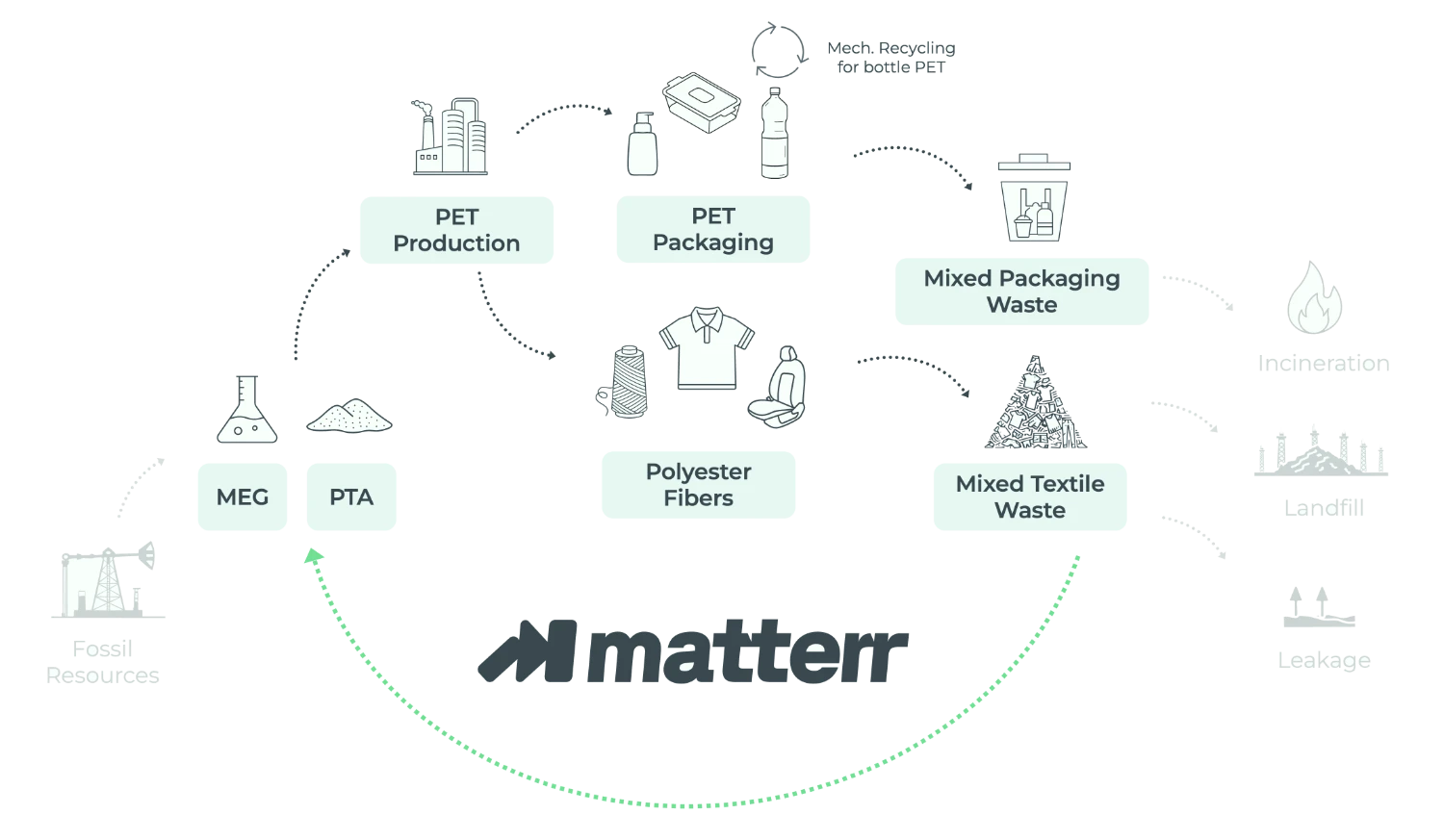
Mechanical recycling preserves the existing polymer structure but is limited by degradation, contamination, and complex material compositions.
Our depolymerisation technology takes a different approach: it restores polyester at the molecular level, enabling the regeneration of virgin-quality raw materials from challenging waste streams.
This allows us to process materials that conventional recycling cannot handle, including blended textiles, multilayer packaging, and other complex polyester waste streams.
Our technology produces virgin quality monomers that can directly replace fossil based inputs in existing polyester production.
As drop in ready materials, they are compatible with established polyester value chains. Existing polyester manufacturing infrastructure can continue to be used, with no additional CAPEX investment or downstream process changes required.
Like this, we enable polyester to become circular without rebuilding the industry from scratch.
Our process starts with polyester waste streams containing at least 80% polyester, from applications such as blended polyester textiles, technical textiles, or multilayer PET packaging.
The waste is shredded and textiles are compacted into uniform pellets, creating a consistent material that can be fed into the recycling process.
This is where the magic happens: Through depolymerisation, polyester is broken down into its molecular building blocks. The process takes place within seconds at moderate temperatures, without high pressure, and in continuous operation.
The dissolved polyester building blocks are separated from fibre residues, dyes, and other impurities through filtration and purification, resulting in a high-purity solution.
The two key polyester building blocks, PTA and MEG, are separated and recovered at high purity. The result: pure monomers, ready to be used again to produce new polyester in existing value chains.

The process expands the range of polyester waste streams that can be recycled.

Depolymerisation happens in under one minute at moderate temperatures, supporting low operating costs.

Monomers match the quality of fossil-based raw materials and can be used to make polyester with the same quality and performance as virgin polyester.

Produced monomers can be directly integrated into existing polyester production systems.


